Samples, materials, protocols, instruments, measurements, events, identities.
Constellations, compressed
The shortest serious path through the argument: what science is missing, what stack can replace that absence, and why this is an ecosystem thesis rather than another AI-tool thesis.
If you only remember three things
- The crisis is not only missing knowledge. It is failed transmission.
- Papers are renderings, not the durable record layer science needs.
- Vela is the first concrete wedge: structured scientific state that can change what researchers and agents do next.
The Inheritance
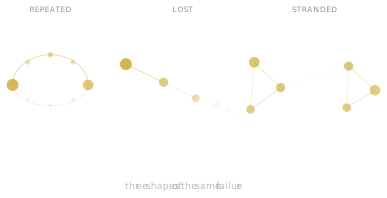
The deepest failure in science is often not discovery, but transmission.
The essay begins from a simple structural truth: knowledge can exist, be documented, even be textbook, and still fail to arrive where it is needed. That is not an edge case. It is the pattern. A field can know more than any one person, yet still fail to carry that knowledge through institutions, handoffs, and time.
Borrowed Light names that failure as infrastructural. The problem is not only ignorance. It is weak inheritance. Signals accumulate in charts, papers, protocols, and local judgment, but too often nothing forces the pattern to become visible in time — or gives the field a shared memory it can keep building on.
Return to this section in the essay
The Pattern
The paper is not the atom of science. It is a rendering.
Published papers are legible to humans, but they are terrible as the durable working medium of a field. A single paper compresses many claims, conditions, measurements, scopes, and uncertainties into one narrative artifact. Citation preserves far less structure than the underlying work contains.
That matters more in the age of AI, not less. Better models do not solve the substrate problem. They magnify it. If the underlying record remains prose-first, every human and every agent keeps rebuilding the same map from scratch.
Return to this section in the essay
Rendering versus record
The paper stays. What changes is the layer beneath it.
The paper is the human-facing artifact. It helps a field read itself, but it leaves protocols, measurement events, and correction state trapped below the surface.
The record remains readable, but it can now be queried, revised, and tied back to what was actually measured. That is where the operating system begins.
The Foundation
Science needs a stack, not a prettier interface layer.
The essay's architectural claim is that science is missing the layered infrastructure software already has: a kernel of measured reality, a state layer for findings and dependencies, an interpretation layer, a runtime for execution, and a network for federation and inheritance.
If the lower layers are weak, every higher layer stays brittle. You get better search, nicer dashboards, and more private context windows, but not durable compounding. Once those lower layers become real, the opposite becomes possible: richer interfaces, stronger institutions, and eventually the kind of scientific ecosystem software already enjoys.
Return to this section in the essay
The scientific operating system
Five layers, from physical substrate to institutional network. Select a layer to see what it carries.
Findings, evidence objects, typed links, provenance, correction events, dependency graphs.
Observers, policies, institution-specific views, confidence thresholds.
Schedulers, protocol runtimes, lab operating systems, trial surfaces, agent loops.
Standards, archives, governance, incentives, federation.
The Constellation
The constellation is the shared scientific memory layer.
This is the place where findings become first-class objects with explicit evidence, conditions, contradiction, confidence, provenance, and revision. It is not a paper viewer. It is not just a knowledge graph. It is a state surface where the structure beneath the prose becomes visible and updateable.
The key test is correction. A retraction, failed replication, null result, or challenge should not sit beside the record as gossip. It should move through the record as a structural event, updating what downstream claims deserve to be trusted.
Return to this section in the essay
What a correction event changes
The correction should not sit beside the record. It should move through it.
The claim still looks stable
A downstream hypothesis, a clinical hunch, and a review article all rest on the original finding. The record still treats the source claim as live.
A challenge becomes first-class
A failed replication, retraction, or methods challenge enters the record as an event attached to the source finding rather than as a detached footnote.
Dependents update through the graph
Everything that depended on the challenged claim now carries that changed state. The field does not have to rediscover the same warning one lab at a time.
The Gigafactory
The runtime closes the loop between thought and contact with reality.
Borrowed Light is not only about preserving scientific state. It is about what happens when protocols, execution, measurement, provenance, and updated state become part of one continuous loop. That is the difference between archival knowledge and a living scientific operating system.
As hypothesis generation gets cheaper and physical verification stays scarce, runtime quality becomes civilizationally important. The field that can learn cleanly from every run compounds. The field that cannot keeps paying to rediscover its own dead ends.
Return to this section in the essay
How the execution loop compounds
From protocol to measured state and back again. Select a stage to follow the loop.
Protocol becomes executable
The runtime starts from a structured protocol, not a paper paragraph. The plan is legible enough for instruments, schedulers, and reviewers to act on.
Execution is coordinated
Instruments, patients, samples, and staff are the scarce loop. The runtime decides what runs where, and preserves what actually happened.
Measurement carries its context
Calibration, uncertainty, and sample lineage travel with the result. The output is not just a number but a measured event with conditions attached.
Provenance makes the run reusable
The record preserves the protocol, materials, operators, and deviations that shaped the outcome, so later work can trust or challenge it intelligently.
Shared state updates immediately
The result enters the field as a byproduct of the work itself. The next query starts from what just happened instead of waiting months for a paper.
Where to go next
If you want the worldview in full, read the essay. If you want the first concrete instantiation, go to Vela. If you want the bounded, evaluator-facing test of the thesis, go to Proof. If you want the ecosystem-level build note — what science is missing and why those layers are now buildable — go to Build.